Another of my students sent me this article from the NYT (and I have to point out here the wonderful thing about having a bunch of students every year. I have, generally, at least one hundred new people to learn from every single year and sometimes they keep teaching me things after they've left my classroom. Reason number 37 that it is great to be a teacher) and I found it intriguing for a variety of reasons.
The first is a common theme, at least for me, and that is the enormous disappointment I feel that no one is looking beyond test scores to measure teacher performance. Ms. Green writes at length about the other things, but it always comes back to the test scores. She concludes with the wisdom of Thomas Kane, an economist who studies education (clearly he won't have a very particular outlook on what education should look like or how it should be measured) who says that if we could just improve the teachers we have "we could close the gap between the United States and Japan on those international tests within two years."
Forgive me if you've heard this one before, but why do we want to close those test score gaps again? Are Japanese citizens happier by and large than Americans? Are they healthier? Are these the results of them scoring higher on standardized tests? What are some of the consequences of the drive to score better on those tests?
While I lived in Korea, one of the things that struck me was the amazing pressure that student are under to perform on the final test they take as high schoolers. Kids go to school year round every day, often spending at least 16-20 hours away from home either at school, at after-school study facilities, and then at late-night study rooms which they rent for the year. If they don't perform as well as they'd hoped, they will often take another year just to study for the exam.
According to my relatively limited understanding, the tests in Japan are even more insane, and the response among students is similar. They use incredible amounts of time and energy spent to study for them and are often crushed when they don't rank as highly as they hope.
In an article written in 2007, Leila Madge describes some of the incredible focus placed on these tests by parents and students alike:
In the last year of middle school and high school Japanese
students go through what they call “examination hell.”
In February and March they take highly competitive
exams. How well they do determines not only the next
school they will attend but also what kind of job, spouse,
social status and lifestyle they will enjoy in the future.
The importance of the exam in the current Japanese
educational system started in the Meiji period (1868-
1912). Before that time, government positions had been
filled by samurai. With the end of that system, and the
end of the caste system, education began to be used to
decide who would have what kind of jobs. Since the end
of World War II, education has been a means for upward
mobility, especially for the middle-class who have no
business or land to will to their sons.
Economic growth, the democratization of Japanese
society and new job opportunities in the post-war years
meant competition for higher education increased along
with the pressures of exams. This period of “examination
hell” is not unique to Japan but characterizes much of
East Asia (Korea and China) which share a heritage of
Confucian respect for scholarly endeavors and family
obligation. China and Korea also currently understand
exams as a way to get ahead in society.
What is school and home life like for students and
parents during examinations? As the time for exams
draws near all non-academic activities such as music and
sports clubs are put on hold. All classroom learning is
geared towards memorizing factual information. After
school, children attend cram schools (juku in Japanese
and hakwon in Korean) or study with tutors, and
vacations are spent attending special study camps.
Many students of more ambitious families have been
participating in these activities since kindergarten. Some
students barely eat, sleep or even bathe. A common
expression in both Japan and Korea is “Pass with four
(hours of sleep), fail with five.” Parents have felt the stress
of this time since their children started school. Fathers
feel they must earn enough to provide the money for
tutors and tuition at cram schools. Mothers strive from
the time their kids start kindergarten to provide them
with a home life to reinforce school lessons, fulfill the
child’s physical needs and work with teachers to make
sure their kids get lots of attention at school. Mothers
are often praised or criticized by family members, and
in newspaper or television shows, for their children’s
school successes.
Parents, students, business leaders and government
officials like the exam system, even if it is hellish.
Ironically, just as American corporate leaders, politicians
and educators are looking to imitate the Japanese
exam system with standardized exams, the Japanese
are thinking of changing their own system. During
“examination hell,” suicide, violence at school and home,
and dropout rates increase. Since the 1990s, with an
economic downturn in Japan, the rewards of the system
aren’t so great any more. In addition, many business
leaders and government officials are blaming Japan’s
economic woes on workers’ inability to creatively compete
in a 21st century global economy. For this, they blame the
education system. Many wonder if the pressure of exams
is worth it and educational reform is now a hot topic in
Japan. Reformers often look to the United States and call
for more flexible curricula, fewer school days, abolishing
uniforms — all to encourage more student creativity and
engagement with the real world.
So, if educational leaders in Japan are trying to make their system more like ours, and we are trying to make ours more like theirs, couldn't we try to communicate with them to learn the pitfalls of the increased emphasis on testing? Shouldn't we spend some time looking at the developments in their society over the last 100 years with this incredible emphasis on these tests and on the standardization of students' experience? If they are thinking seriously about less time in school, more flexible curricula, abolishing uniforms, etc., perhaps there are values to those things within our current system? Perhaps more time in school, more tests, more nationally mandated curricula are not the answer?
So back to the problem at hand and the one addressed by the article. Despite a stated focus on things other than tests when it comes to "good teachers," it turns out to be the single determining factor in this article as well as so many other recent publications about "good" teachers including the recent article in the Atlantic about "What Makes a Great Teacher." (On a personal note, I have to admit that I don't really think great teachers would fill one ear on their head (of only two that they have) with a bluetooth headset, but that is just a personal opinion.)
I will do my best to point out some of the very good things about the article, but I have to finish this post with just one more glaring omission. The article assumes, as most do, that teachers are actually able to decide what they want to do in their classroom and how they want to go about doing it. The fact of the matter is that even in most of the "best" schools in the country, teachers are completely and totally bound by the decisions of the administration. They are told what to teach, what to test for, when to teach it, and often how to teach it. So if you want to hold people accountable, a great place to start is with administrators since they are the only real "principals" making decisions in most school situations. Teachers are agents only of the school, the district, and the state and as such cannot be held accountable because they don't get to decide for themselves what their students really need, etc.
While I am happy that so many intelligent people are thinking hard about how to fix education, it is disheartening to find so many of the basic assumptions avoiding real questioning. I do not claim to have the solution, so perhaps I cannot be the one pointing out all the faults, but I do know that perhaps a better place to start would be asking questions like "What are students learning from preparing for and taking so many high-stakes tests?" "Has education improved since we made it compulsory in the United States?" "What things have improved since education was made compulsory and have they improved at a faster rate since we started focusing on standardization?" "Is it possible to standardize human experience in any healthy way?"
In fact, I will end with my personal favorite. Can someone define for me in a meaningful way what the term "student achievement" means? We spend lots of time and money focusing on it, and Ms. Green's article focuses on finding teachers that are good at or helping teachers improve their students ability to "achieve" on these standardized tests. What are they achieving exactly?
Tuesday, March 09, 2010


Monday, March 08, 2010
Mad props
Go again to Keith Williams of Williams Cycling who rejected our inquiry about sponsorship for the Velo Aces but actually found my email in his spam folder and still responded. Perhaps this is ridiculous, but I am becoming more and more confident that this guy and his company do fantastic work. I can't wait until the 85mm wheels come out. It looks like I might be able to borrow a front wheel from a pal of mine and if I can throw one of those on the back... Should be super. And then when I am rich and famous I will have a disc wheel just for the incredibly cool thunking sound it makes when you shift. I definitely am more enamored of the noise than I am of potential performance gains.
Also, in case anyone else is reading this and actually curious about the Velo Aces, jerseys should actually be available at Main Line Cycles within 8 weeks. They are only going to stock a limited number so you will have to get there to make sure you get them. They also put up a video from the group ride this weekend, Laubach is making it big!
Also, in case anyone else is reading this and actually curious about the Velo Aces, jerseys should actually be available at Main Line Cycles within 8 weeks. They are only going to stock a limited number so you will have to get there to make sure you get them. They also put up a video from the group ride this weekend, Laubach is making it big!
Kohlberg and the University of Chicago
A former student sent me an email containing a link to W.C. Crain's 7th chapter of Theories of Development in which he discusses Kohlberg's stages of development. In the opening paragraphs, Crain discusses the life of Lawrence Kohlberg and at one point he mentions that "in 1948, he enrolled at the University of Chicago, where he scored so high on admissions tests that he had to take only a few courses to earn his bachelor’s degree." It struck me that his entrance to college along with the experience he had as a working man (apparently he was the second Engineer on a freighter helping transport Jews from Europe to Israel for several year after high school) would certainly give him the impetus to try to get his bachelor's degree so he could move on. But I wonder if someone would have a similar option today. (I emailed the dean of students at UofC to find out, hopefully I will have a definitive answer soon)
We have come to expect nearly everyone to go to college and obtain some type of degree, but I think at the same time it has become next to impossible to be granted that degree without taking a certain number of courses, regardless of the level of personal expertise or understanding of the field in which the degree is to be granted. Perhaps I have grown too cynical of late, but I tend to think a great deal of that is tied to the economics of the issue. If you were just granting degrees without forcing students to take a large amount of coursework first, your degree might not be seen as worth the fifty thousand dollars a year you are charging students to go there. This would be a disaster for any school that is chasing rankings and the prestige and money that go with them. It would also be the nail in the coffin for US News and World Report whose only profitable issue is the one in which they rank schools so everyone will know where to go, or try and go, in the fall.
Follow this backward to the instutionalization of the Carnegie Unit, the so called standard that was called for when someone decided that student experience in any one place had to be somehow comparable to student experience in another. (An interesting discussion of the history of the Carnegie Unit can be found here) Apparently it wasn't enough to have examinations designed by professors and other leaders in various fields, a seat-time component had to be introduced so that US News and World Report could make a profit on their magazine.
In watching a few students here and there, it is apparent that the seat-time system of comparison is at least as flawed as was the original one based on various examinations. The fact of the matter is that students learning varies according to so many variables that pretending that they are going to have, or need, the same experience to master a certain subject or concept is rather absurd. To me anyway.
So if we are going to continue to require degrees for various jobs, despite the fact that it is acknowledged on a wider and wider scale that degrees are not significant indicators of ability or sometimes even a similar background knowledge of skills, why shouldn't we go back to a system that would allow someone with a great deal of experience or knowledge in a certain subject to be granted a degree in their field if they pass certain examinations or demonstrate their mastery in some way? If an accomplished writer decides after skipping college to return later in life to take some courses, will you force them to take Freshman Composition?
Please don't get me wrong, I am all for Freshman Composition, but only for the folks that need it. (In point of fact, I am really only for it for the folks that want it, if a brilliant scientist finds out later in life that writing is more necessary than they imagined, and they likely will, they will either learn to write effectively enough or pay someone else to do it. This creates jobs for English majors, something I am always in favor of and eliminates more extremely unwilling and miserable Freshman Comp. students thereby making the class more fun and perhaps even more valuable for us English majors. If I were John Hodgman I would ask you to say thank you since I just solved that one nicely!)
Some school systems have created exams that allow students to test out of certain classes. There is even some talk that the soon to be released Keystone Exams will allow that in Pennsylvania, but right now information is extremely hard to come by and relatively contradictory. But if we must continue to place value in standardized tests and will continue to force children everywhere to take them, we ought to seriously consider using them to allow students to test out of some of the seat-time requirements which would create a real reward for doing well on standardized tests if they could then take more electives or perhaps have half the school day off to go and get a job and buy more ipods or iphones or isecondlives or whatever they want.
We have come to expect nearly everyone to go to college and obtain some type of degree, but I think at the same time it has become next to impossible to be granted that degree without taking a certain number of courses, regardless of the level of personal expertise or understanding of the field in which the degree is to be granted. Perhaps I have grown too cynical of late, but I tend to think a great deal of that is tied to the economics of the issue. If you were just granting degrees without forcing students to take a large amount of coursework first, your degree might not be seen as worth the fifty thousand dollars a year you are charging students to go there. This would be a disaster for any school that is chasing rankings and the prestige and money that go with them. It would also be the nail in the coffin for US News and World Report whose only profitable issue is the one in which they rank schools so everyone will know where to go, or try and go, in the fall.
Follow this backward to the instutionalization of the Carnegie Unit, the so called standard that was called for when someone decided that student experience in any one place had to be somehow comparable to student experience in another. (An interesting discussion of the history of the Carnegie Unit can be found here) Apparently it wasn't enough to have examinations designed by professors and other leaders in various fields, a seat-time component had to be introduced so that US News and World Report could make a profit on their magazine.
In watching a few students here and there, it is apparent that the seat-time system of comparison is at least as flawed as was the original one based on various examinations. The fact of the matter is that students learning varies according to so many variables that pretending that they are going to have, or need, the same experience to master a certain subject or concept is rather absurd. To me anyway.
So if we are going to continue to require degrees for various jobs, despite the fact that it is acknowledged on a wider and wider scale that degrees are not significant indicators of ability or sometimes even a similar background knowledge of skills, why shouldn't we go back to a system that would allow someone with a great deal of experience or knowledge in a certain subject to be granted a degree in their field if they pass certain examinations or demonstrate their mastery in some way? If an accomplished writer decides after skipping college to return later in life to take some courses, will you force them to take Freshman Composition?
Please don't get me wrong, I am all for Freshman Composition, but only for the folks that need it. (In point of fact, I am really only for it for the folks that want it, if a brilliant scientist finds out later in life that writing is more necessary than they imagined, and they likely will, they will either learn to write effectively enough or pay someone else to do it. This creates jobs for English majors, something I am always in favor of and eliminates more extremely unwilling and miserable Freshman Comp. students thereby making the class more fun and perhaps even more valuable for us English majors. If I were John Hodgman I would ask you to say thank you since I just solved that one nicely!)
Some school systems have created exams that allow students to test out of certain classes. There is even some talk that the soon to be released Keystone Exams will allow that in Pennsylvania, but right now information is extremely hard to come by and relatively contradictory. But if we must continue to place value in standardized tests and will continue to force children everywhere to take them, we ought to seriously consider using them to allow students to test out of some of the seat-time requirements which would create a real reward for doing well on standardized tests if they could then take more electives or perhaps have half the school day off to go and get a job and buy more ipods or iphones or isecondlives or whatever they want.
Thursday, March 04, 2010
George Will's article in the Washington Post
Yesterday, Mr. Will wrote an interesting article about the way to ruin a child. He brings up some things that some of us who see high school kids every day think are common sense, but it is great to see him bringing them up as people tend to believe commentators with political clout more than your average high school teacher!
Go ahead and read the article here but pay particularly close attention to the part about why we start high school when we do and the various physical and psychological effects. As a teacher, I find ways to deal with the fact that my students are still generally asleep at 7:30 and just starting to come around an hour or sometimes two hours later. Obviously I can't change the starting time of my school or anybody else's school, but I could add reams of anecdotal evidence to support what Will points out, namely that putting kids in high school is good for some people, but certainly not for the kids!
I have a friend who attended the same high school I teach in many years ago, a few friends actually. Back then, they went from 9 or 9:30 to 3:00. These friends have widely varying careers, from welding to engineering nuclear power plants. They don't appear to be any less intelligent or have dealt with any less complicated issues or questions than the students I have today. So why must we have them in school at hours that are unhealthy for them?
And please don't think that I would mind being at school from 7:30 to 3:00, generally I am there from 6:30 until at least 4:30 already, but that includes coaching and some time for me to exercise. If I had the 90 minutes from 7:00 until 9:30 to plan or grade or do whatever I needed to do, I can guarantee that every lesson would be better, feedback would get back sooner, and if my students got out at 3:00, I would be happy to bet that their test scores or many other measures of "student achievement" would certainly not go down and likely would climb. An extra hour of sleep would change the entire landscape of most of my students' lives. There is absolutely nothing I or any other teacher could do that would have anything like that positive effect.
But if we were really trying to do what is best for our students and our kids, starting later would be one in a flurry of changes that would quickly revolutionize the way we approach education in this country. So I don't want to pretend that it is the only thing to fix either, but it is one that seems obvious enough even for the educational establishment not to be able to ignore much longer. I hope.
Go ahead and read the article here but pay particularly close attention to the part about why we start high school when we do and the various physical and psychological effects. As a teacher, I find ways to deal with the fact that my students are still generally asleep at 7:30 and just starting to come around an hour or sometimes two hours later. Obviously I can't change the starting time of my school or anybody else's school, but I could add reams of anecdotal evidence to support what Will points out, namely that putting kids in high school is good for some people, but certainly not for the kids!
I have a friend who attended the same high school I teach in many years ago, a few friends actually. Back then, they went from 9 or 9:30 to 3:00. These friends have widely varying careers, from welding to engineering nuclear power plants. They don't appear to be any less intelligent or have dealt with any less complicated issues or questions than the students I have today. So why must we have them in school at hours that are unhealthy for them?
And please don't think that I would mind being at school from 7:30 to 3:00, generally I am there from 6:30 until at least 4:30 already, but that includes coaching and some time for me to exercise. If I had the 90 minutes from 7:00 until 9:30 to plan or grade or do whatever I needed to do, I can guarantee that every lesson would be better, feedback would get back sooner, and if my students got out at 3:00, I would be happy to bet that their test scores or many other measures of "student achievement" would certainly not go down and likely would climb. An extra hour of sleep would change the entire landscape of most of my students' lives. There is absolutely nothing I or any other teacher could do that would have anything like that positive effect.
But if we were really trying to do what is best for our students and our kids, starting later would be one in a flurry of changes that would quickly revolutionize the way we approach education in this country. So I don't want to pretend that it is the only thing to fix either, but it is one that seems obvious enough even for the educational establishment not to be able to ignore much longer. I hope.
Get out of his bike lane!
Sweet pictures of all kinds of fun bike lane violations. I thought of it this morning when I saw that the maximum fine for driving in a bike lane was 50 bucks, at least for the bike lane on Bryn Mawr Ave heading away from the city.
Bike Lane Violations
(there are some other great ones at the related blog, I just liked this one the most)
The other great part of the morning was when a woman dropping her high school age daugther off at the bus stop almost killed me so she could swing into the road just ahead of the bus, block both lanes and just about crush me in the process. Good times, good times.
Like a lot of folks I am reading lately, riding a bike more just makes you hate cars more. It makes you happier, healthier, wiser (at least in my own mind) and fills you frequently with a bitter, bitter kind of rage for the way that cars not only make people incredibly stupid and reckless, but also incredibly dangerous at the same time. Hoooray for cars!
(disclaimer: I own a car and I really like driving it. Zoom Zoom and all that. So I am a hypocrite. Just wanted to put that out there)
Bike Lane Violations
(there are some other great ones at the related blog, I just liked this one the most)
The other great part of the morning was when a woman dropping her high school age daugther off at the bus stop almost killed me so she could swing into the road just ahead of the bus, block both lanes and just about crush me in the process. Good times, good times.
Like a lot of folks I am reading lately, riding a bike more just makes you hate cars more. It makes you happier, healthier, wiser (at least in my own mind) and fills you frequently with a bitter, bitter kind of rage for the way that cars not only make people incredibly stupid and reckless, but also incredibly dangerous at the same time. Hoooray for cars!
(disclaimer: I own a car and I really like driving it. Zoom Zoom and all that. So I am a hypocrite. Just wanted to put that out there)
Wednesday, March 03, 2010
Wheel Conundrum
So its true, wheels are one of the biggest things that determine how fast you can go on your bike. Once you've actually gotten yourself in shape, you can give yourself a big advantage with a fancy set of wheels, particularly when it comes to a time trial. I've lusted after a pair for a while, but never really thought it was possible, mostly since they cost so darn much.
After a few forays into the world of online money-making, I still don't have the cash. But there is hope that this summer I can find a way to pull it together.
So I started to really think that I might have a pair of Zipp 808s before too much longer as I'd settled on those as the best option for me. Almost all the racing I do is TTs or TTTs so I don't really need something like the 404s since they are fantastically versatile but I am looking for something really aero and I am not concerned as much about weight. Plus there's always the chance that my friend will let me borrow his 303s if I am in a real good climbing race, my only mass start love.
But something caught my eye this morning as I was perusing cyclingnews.com. They mentioned an upcoming review of the Williams 58 carbon tubulars. So I went to Williams' website to check things out. The 58mm carbon clincher really caught my eye. First of all, the obvious. A quality aero wheelset for 1000 bucks that includes swiss stop pads and skewers. This is not a common thing.

Then claims of serious durability without excessive weight... So I figured I would watch the testrider.com review of them available at the Williams site here:
Williams 58mm Carbon Clincher
Ok, so it is more of a competitor of the 404 than I thought, but does that make it a bad thing? That would suggest that I could race with them just about whenever, and I wonder what the real performance gains are going to be for me running 808s in a TT, since I am not going to be averaging 33mph for a 40K anytime soon. I can't say I understand the science better than the next average guy, but the toroidal shape of the 404s or 808s and the more expensive highly nuanced dimple system etc. are certainly going to make me faster, but are they a grand faster for an average guy who wants to win races but can't claim any real palmares on two wheels?
Especially when you add in the durability that is such a big part of it (though I have only heard really good things about Zipps in that regard as well) and the braking performance and the fact that they include everything you need in the package...
Right now I am leaning heavily towards the 58s though I had to pause when I got a note from Keith Williams, the president and founder of Williams Cycling, where he noted that they are going to come out with an 85mm deep wheel within a few months. I was also impressed and heartened since a guy running the show was willing to get back to me about a question within hours and I haven't even spent any money on them yet! That can only bode well for customer service and certainly the idea that they really stand behind their products.
Obviously I will keep you posted as the process continues. Hopefully I will have some pictures of my Argon18 Mercury with a beautiful set of aero wheels to share come later this Spring! The Williams wheels will look at least as good as these Zipps, and they will match my Helium as well!

After a few forays into the world of online money-making, I still don't have the cash. But there is hope that this summer I can find a way to pull it together.
So I started to really think that I might have a pair of Zipp 808s before too much longer as I'd settled on those as the best option for me. Almost all the racing I do is TTs or TTTs so I don't really need something like the 404s since they are fantastically versatile but I am looking for something really aero and I am not concerned as much about weight. Plus there's always the chance that my friend will let me borrow his 303s if I am in a real good climbing race, my only mass start love.
But something caught my eye this morning as I was perusing cyclingnews.com. They mentioned an upcoming review of the Williams 58 carbon tubulars. So I went to Williams' website to check things out. The 58mm carbon clincher really caught my eye. First of all, the obvious. A quality aero wheelset for 1000 bucks that includes swiss stop pads and skewers. This is not a common thing.

Then claims of serious durability without excessive weight... So I figured I would watch the testrider.com review of them available at the Williams site here:
Williams 58mm Carbon Clincher
Ok, so it is more of a competitor of the 404 than I thought, but does that make it a bad thing? That would suggest that I could race with them just about whenever, and I wonder what the real performance gains are going to be for me running 808s in a TT, since I am not going to be averaging 33mph for a 40K anytime soon. I can't say I understand the science better than the next average guy, but the toroidal shape of the 404s or 808s and the more expensive highly nuanced dimple system etc. are certainly going to make me faster, but are they a grand faster for an average guy who wants to win races but can't claim any real palmares on two wheels?
Especially when you add in the durability that is such a big part of it (though I have only heard really good things about Zipps in that regard as well) and the braking performance and the fact that they include everything you need in the package...
Right now I am leaning heavily towards the 58s though I had to pause when I got a note from Keith Williams, the president and founder of Williams Cycling, where he noted that they are going to come out with an 85mm deep wheel within a few months. I was also impressed and heartened since a guy running the show was willing to get back to me about a question within hours and I haven't even spent any money on them yet! That can only bode well for customer service and certainly the idea that they really stand behind their products.
Obviously I will keep you posted as the process continues. Hopefully I will have some pictures of my Argon18 Mercury with a beautiful set of aero wheels to share come later this Spring! The Williams wheels will look at least as good as these Zipps, and they will match my Helium as well!

My Leader
A few years ago I decided I would build a single-speed bike because single speed bikes make you cooler. I bought a frame from Performance before I decided against it months later (though they were nice enough to take the frame back and give me a full refund). A while after that I was going to buy a Leader Track Frame, the 735 I believe, but it was sold out forever and ever. So, once they finally did get some in stock, I bought a different frame instead! The Leader 720TR (and this picture may or may not work, perhaps I should take a photo of my own and throw it up here, but this will be good to see what it looks like before it gets thrashed)

.jpg)
.jpg)
So if you are looking for a great frame to start with, I'd recommend the Leader. Cool enough that you don't feel bad about the fact that it is really inexpensive. The other parts have also held up well. Someday I look forward to putting a real single-speed wheel on the back so I don't have to jam this one in anytime I take it out. Outside of that, I think this thing is going to keep doing a great job of getting me to work with some extra riding here and there.
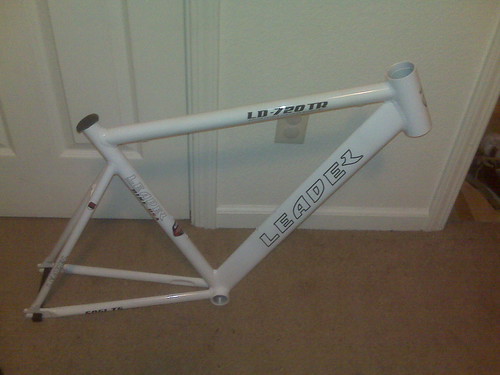
So I picked up the frame and a sweet T-shirt from Leader, threw on a cheap fork from Performance and mostly gathered parts left over from building my wife's bike, a pair of wheels a buddy gave me years ago, and the spacers from a Nashbar single speed conversion kit. I threw the bike together with a little help from the guys at Cycle Fit in Wallingford and started riding it to work. I have changed a few things around but generally its had the same bits since then and its been absolutely fantastic.
I built the bike from inexpensive parts (though I am sure lots of people could do it better, this was my first attempt after all) because I didn't want to worry about it, not in the rain, not sitting on my porch, not worry at all. But it has been really fun to ride, especially with a few modifications:
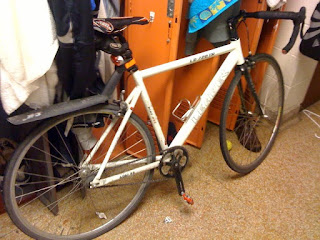
The bike in it's natural habitat, the closet locker room:
.jpg)
I double wrapped the top of the bars with some fancy Bontrager "double gel" tape since the rather cheap aluminum does send some road chatter through the frame and into my hands. Really easy to do and makes a noticeable difference. I switched the brake pads that came with my FSA brakes to a pair of shimano pads and it made a HUGE difference. The really cheap pads sprayed black nastiness all over my bike and didn't really stop all that well. Just switching the pads brought them close in performance to my Shimano Ultegras.
I also grabbed an SKS Xtra-dry fender a year or so ago and that has been a nice addition, particularly because you can throw it on and off in a few seconds. Really helps bring down the incidence of soggy butt.
Last fall I put a pair of Nashbar mountain bike pedals on there and the flashy red paint was an upgrade and they are a lot easier since the other ones I had on there were for SPD-SL cleats but only had an entry on one side.
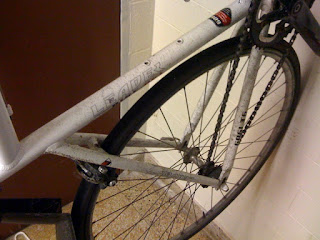
I've pulled the bottom bracket out once and re-greased it (though I think I just re-greased the threads because I don't know how to pack bearings and whatnot so it was probably just a waste of time) because it felt a little bit like I was cranking in sand. I think I felt a difference because I wanted to feel a difference after the time I put in, but generally it has held up great. That is despite all kinds of really gross stuff I ride through and don't clean it up afterwards. Here's a photo of the rear of the bike after this morning's ride:
.jpg)
So if you are looking for a great frame to start with, I'd recommend the Leader. Cool enough that you don't feel bad about the fact that it is really inexpensive. The other parts have also held up well. Someday I look forward to putting a real single-speed wheel on the back so I don't have to jam this one in anytime I take it out. Outside of that, I think this thing is going to keep doing a great job of getting me to work with some extra riding here and there.
36 degrees, feels like 27. Light Wintry mix = perfect riding weather?
With all the snow we've been getting, I've gotten a bit tired of driving to work. I had to do it for nearly two weeks straight. Hard life I know! So this week I said to heck with it and got my trusty Leader back off the porch and into the road. Monday and Tuesday were a little squirrely with all the black ice, but luckily I didn't come to any grief, even on my hour long ride on Tuesday with the messenger bag full of things I shouldn't have bothered bringing home anyway.
This morning I was a bit nervous since I looked out the door and it was raining. I was even more nervous since our puppy decided the weather wasn't enough fun to stay out and play in for a bit and just did her business and came back inside straightaway. Wait a minute, straightaway? Oh I know! Did I mention I like feeling somewhat British after watching too much MI-5? Moving on...
But I figured it couldn't be much worse than yesterday's slippery patches, at least the rain actually lessened the amount of black ice outside. So I got all gussied up in my Cannondale wind-proof (really, they are almost totally wind proof) pants a couple long sleeve shirts, one of them the weird Nike spehere thermal thing with a hood that I got years ago at the Nike Employee Store in Beaverton

put the big Adidas neoprene overshoes over my shoes and then one of my latest and best finds, the Adistar Clima Proof jacket that Nashbar dropped for 35 bucks instead of about 180 last year:

I also wore my cute Milram cap.
And for an hour I motored (well more likely it was only motoring in my mind and more like creeping to everyone else) around town, Haveford Road down to Lancaster, then back into Gladwyn and up and down a few hills, then up and down some more hills (always a pleasure at 6:15 in the morning on a single speed with 42x16 gearing) and then down a hill I didn't mean to go down and eventually right into work. Ended up riding for just about 55 minutes and was completely comfortable. My toes were a bit chilly but they always get a bit chilly. I actually had to open up the jacket as I was getting pretty toasty and my hands were sweating quite a bit in the outer layer of those Specialized gloves I got at the swap meet in Trexlertown this fall.
It was nice to get to work with the legs feeling pretty crapped out, my face not too freezing despite the loss of the face-sweater this weekend, and feeling like I had very little to fear from the weather anymore. Blizzard conditions still frighten me and obviously roads with snow and ice are a no go (although I'd love to try those crazy tires with the metal spikes in them someday, apparently they don't just make them for motorcycles chasing James Bond anymore), but if I can be pretty comfortable on a ride like this morning, it bodes well for future training in the dark of early morning!
This morning I was a bit nervous since I looked out the door and it was raining. I was even more nervous since our puppy decided the weather wasn't enough fun to stay out and play in for a bit and just did her business and came back inside straightaway. Wait a minute, straightaway? Oh I know! Did I mention I like feeling somewhat British after watching too much MI-5? Moving on...
But I figured it couldn't be much worse than yesterday's slippery patches, at least the rain actually lessened the amount of black ice outside. So I got all gussied up in my Cannondale wind-proof (really, they are almost totally wind proof) pants a couple long sleeve shirts, one of them the weird Nike spehere thermal thing with a hood that I got years ago at the Nike Employee Store in Beaverton

put the big Adidas neoprene overshoes over my shoes and then one of my latest and best finds, the Adistar Clima Proof jacket that Nashbar dropped for 35 bucks instead of about 180 last year:

I also wore my cute Milram cap.
And for an hour I motored (well more likely it was only motoring in my mind and more like creeping to everyone else) around town, Haveford Road down to Lancaster, then back into Gladwyn and up and down a few hills, then up and down some more hills (always a pleasure at 6:15 in the morning on a single speed with 42x16 gearing) and then down a hill I didn't mean to go down and eventually right into work. Ended up riding for just about 55 minutes and was completely comfortable. My toes were a bit chilly but they always get a bit chilly. I actually had to open up the jacket as I was getting pretty toasty and my hands were sweating quite a bit in the outer layer of those Specialized gloves I got at the swap meet in Trexlertown this fall.
It was nice to get to work with the legs feeling pretty crapped out, my face not too freezing despite the loss of the face-sweater this weekend, and feeling like I had very little to fear from the weather anymore. Blizzard conditions still frighten me and obviously roads with snow and ice are a no go (although I'd love to try those crazy tires with the metal spikes in them someday, apparently they don't just make them for motorcycles chasing James Bond anymore), but if I can be pretty comfortable on a ride like this morning, it bodes well for future training in the dark of early morning!
Tuesday, March 02, 2010
Everything He Wants To Do IS Illegal!
Would you believe that the USDA is actually making it more difficult to sell safe food? Of course you would because everyone loves conspiracy theories. Or at least to be somewhat angry at large, faceless organizations that we actually control through our votes but we don't really control them because even after we vote for someone there are those big faceless and sometimes nameless organizations that are so good at co-opting everyone... well, that's another story.
But a lot of folks watched "Food Inc." the movie version of Michael Pollan's book and some of Fast Food Nation thrown in there for good measure.
For those that haven't, I'd recommend it but, if you are one of those folks that can lose your appetite just by hearing about gross things even though you've been eating them blissfully for years without any serious trouble, you might not want to eat hamburgers again so I will just give that little spoiler alert.
If you watch the movie, you get to meet a guy named Joel Salatin, the proprietor of Polyface Farms in the Shenandoah Valley of Virginia. This guy is opinionated, well spoken, conservative yet liberal, really fantastically fun to listen to. And he is clearly putting his money where his mouth is. I just wish I could get my mouth around some of his eggs and chickens and the other stuff that the local chefs apparently can't get enough of.
Do you know there's a difference between "free-range" chickens and chickens that actually go outside during their lifetimes? Amazing isn't it! Apparently they taste completely different as well.
The point of all this is this: If you think he's great in the movie, pick up a copy of his book "Everything I Want To Do Is Illegal." It reads like he talks and is thought provoking, hilarious, insightful, challenging and a whole host of other things while still being completely accessible and down to earth.
But a lot of folks watched "Food Inc." the movie version of Michael Pollan's book and some of Fast Food Nation thrown in there for good measure.
For those that haven't, I'd recommend it but, if you are one of those folks that can lose your appetite just by hearing about gross things even though you've been eating them blissfully for years without any serious trouble, you might not want to eat hamburgers again so I will just give that little spoiler alert.
If you watch the movie, you get to meet a guy named Joel Salatin, the proprietor of Polyface Farms in the Shenandoah Valley of Virginia. This guy is opinionated, well spoken, conservative yet liberal, really fantastically fun to listen to. And he is clearly putting his money where his mouth is. I just wish I could get my mouth around some of his eggs and chickens and the other stuff that the local chefs apparently can't get enough of.
Do you know there's a difference between "free-range" chickens and chickens that actually go outside during their lifetimes? Amazing isn't it! Apparently they taste completely different as well.
The point of all this is this: If you think he's great in the movie, pick up a copy of his book "Everything I Want To Do Is Illegal." It reads like he talks and is thought provoking, hilarious, insightful, challenging and a whole host of other things while still being completely accessible and down to earth.
Time Trial Bikes and Tough Guys
So the thought just occurred to me: Much of cycling makes men into sissies that shave their legs, lust after trinkets like Zero Grav brakes or other carbon bits and titanium bits and wheels that cost thousands of dollars. Men have often mocked women or claimed not to understand them due to their inherent desire for diamonds and other such things.
So is cycling really a feminizing influence? Does sitting on a little saddle for that long really do something besides just damage your perineum physically? Is it something about the whole nature of the sport that celebrates a guy with only one testicle over more fully equipped men? Is it the constant leg shaving that lots of casual cyclists can tell you is really just a safety issue while in the back of their minds they are wondering if they will ever be comfortable admitting to you they like having smooth legs.
So I like having smooth legs. Fine.
But back to the womanizing, oops, I mean feminizing influence of cycling. What struck me this evening as I pondered what will always be a hypothetical for a guy like myself, namely what it would feel like to ride one of the new Storck Time Trial bikes:
(this space is an experiment of sorts. I thought I would try "contacting" Storck through their website to ask for permission to post an image of the bike here. If I don't hear back from them, I might take the huge risk and do it anyway. In the meantime, just google "Storck TT bike" and look at the images.
and whether or not you would ruin the whole aesthetic smash you in the face of this bicycle by putting 808s on it that weren't painted in the appropriate white and blue, (take a breath this is a long sentence...) was that the toughest thing in cycling (besides maybe cobbled classics) is the time trial. It is always billed as the race that is won by those who can really suffer, etc. Yet it is also the discipline most closely associated with incredibly specialized and expensive bikes and their accompanying bits and pieces.
So does this mean that even the toughest cyclist, the champion of the time trial, the Lance Armstrong who can suffer more than any mere mortal if you believe half of what folks have said, is really a sissy when it all comes down to it? Are there no tough-guys of cycling? Is Stuart O'Grady not a complete beast? Deep down does he like shaving his legs too?
Maybe we should ask his wife?
So is cycling really a feminizing influence? Does sitting on a little saddle for that long really do something besides just damage your perineum physically? Is it something about the whole nature of the sport that celebrates a guy with only one testicle over more fully equipped men? Is it the constant leg shaving that lots of casual cyclists can tell you is really just a safety issue while in the back of their minds they are wondering if they will ever be comfortable admitting to you they like having smooth legs.
So I like having smooth legs. Fine.
But back to the womanizing, oops, I mean feminizing influence of cycling. What struck me this evening as I pondered what will always be a hypothetical for a guy like myself, namely what it would feel like to ride one of the new Storck Time Trial bikes:
(this space is an experiment of sorts. I thought I would try "contacting" Storck through their website to ask for permission to post an image of the bike here. If I don't hear back from them, I might take the huge risk and do it anyway. In the meantime, just google "Storck TT bike" and look at the images.
and whether or not you would ruin the whole aesthetic smash you in the face of this bicycle by putting 808s on it that weren't painted in the appropriate white and blue, (take a breath this is a long sentence...) was that the toughest thing in cycling (besides maybe cobbled classics) is the time trial. It is always billed as the race that is won by those who can really suffer, etc. Yet it is also the discipline most closely associated with incredibly specialized and expensive bikes and their accompanying bits and pieces.
So does this mean that even the toughest cyclist, the champion of the time trial, the Lance Armstrong who can suffer more than any mere mortal if you believe half of what folks have said, is really a sissy when it all comes down to it? Are there no tough-guys of cycling? Is Stuart O'Grady not a complete beast? Deep down does he like shaving his legs too?
Maybe we should ask his wife?
A couple random things
So, I am looking forward to actually racing this spring. No more racing the wall of my basement on the trainer, no more racing to work in the freezing darkness, and best of all, no more racing on those horrid spin bikes. Glad to get a workout in but those things are terrible.
Also this:
Why does the neighborhood buck?
I actually really like my neighborhood. Two days ago someone came over and asked for some butter. I loved it, good thing we had some to give away!
Also this:
Why does the neighborhood buck?
I actually really like my neighborhood. Two days ago someone came over and asked for some butter. I loved it, good thing we had some to give away!
Tuesday, October 13, 2009
Where we go from here
I've been reading a few things recently:
Turning Learning Right Side Up by Russel L. Ackoff and Daniel Greenberg
Reflections on the Sudbury School Concept edited by Mimsy Sadofsky and Daniel Greenberg
and lots of other stuff too, but those two have been interesting, to say the least.
I heard about the Sudbury Valley School from my sister, as she considered it as an option for my nephew who is apparently doing very well in a public school near their home so I won't get to hear about it from them. Not yet anyway.
So I poked through their website, ordered a couple books, and found that I am not the only person who finds fault in the current system of public education, even in one of its supposedly most successful and "best" school systems.
One of the major concepts of both books is the conflict between democratic society and our major systems of education which are almost exclusively autocratic in nature. The authors in both books often ask the question: How is it possible to help young people to learn to function effectively in a democratic society by training them in an entirely autocratic one for the duration of adolescence?
Good question.
I'd argue that it works very very well, depending on what your goals for that "education" are. Today I was sitting in the classroom with another class where Freshmen were more than willing to send out the troops to quell a rebellion if the lower classes got upset about the concentration of power and wealth in the ruling class. They were giggling about it. "SEND OUT THE PANZERS" one of them yelled. Clearly something is working...
Another post for another time perhaps.
I decided that I'd like to create a more democratic environment within my classroom, but it will be interesting to see how much of that is possible given the constraints of the autocratic system within which all of us function.
The first task, I decided, was to try and figure out exactly what the students in a given class are expected to learn by the end of the year. Getting this information is not difficult, but actually figuring out what is meant by the curriculum writers can be a tad more complicated than you'd expect.
Maybe you'd like to take a shot at interpreting it.
Here are the goals for the English IVH class:
Students will employ sophisticated ideas, specific and illustrative content, precise language, and logical organization as a speaker in forma l and informal settings.
Students will demonstrate responsiveness and engagement while listening in formal and informal settings.
Students will read and evaluate texts for literacy value and personal application through detailed elaboration and extension of ideas, insights, and reflections.
Students will identify, analyze, and evaluate writer’s intent in non-fiction.
Students will make challenging individual reading selections, complete books on their own, and demonstrate through understanding of what they have read, extending beyond the literal to the personal, critical, and/or evaluate.
Students will consistently and independently identify and employ an appropriate writing mode to engage a specific audience, address a specific purpose, and arrive at a product assessed at highest levels of the PA Wr5iting Assessment Holistic Scoring Guide.
Students will consistently and independently apply writing conventions through composition, personal revision, and peer editing/criticism to arrive at a product assessed at highest levels of the PA Writing Assessment Holistic Scoring Guide.
Students will independently choose and thoroughly research a topic of personal significance and synthesize information in order define, verify and present a point of view.
Turning Learning Right Side Up by Russel L. Ackoff and Daniel Greenberg
Reflections on the Sudbury School Concept edited by Mimsy Sadofsky and Daniel Greenberg
and lots of other stuff too, but those two have been interesting, to say the least.
I heard about the Sudbury Valley School from my sister, as she considered it as an option for my nephew who is apparently doing very well in a public school near their home so I won't get to hear about it from them. Not yet anyway.
So I poked through their website, ordered a couple books, and found that I am not the only person who finds fault in the current system of public education, even in one of its supposedly most successful and "best" school systems.
One of the major concepts of both books is the conflict between democratic society and our major systems of education which are almost exclusively autocratic in nature. The authors in both books often ask the question: How is it possible to help young people to learn to function effectively in a democratic society by training them in an entirely autocratic one for the duration of adolescence?
Good question.
I'd argue that it works very very well, depending on what your goals for that "education" are. Today I was sitting in the classroom with another class where Freshmen were more than willing to send out the troops to quell a rebellion if the lower classes got upset about the concentration of power and wealth in the ruling class. They were giggling about it. "SEND OUT THE PANZERS" one of them yelled. Clearly something is working...
Another post for another time perhaps.
I decided that I'd like to create a more democratic environment within my classroom, but it will be interesting to see how much of that is possible given the constraints of the autocratic system within which all of us function.
The first task, I decided, was to try and figure out exactly what the students in a given class are expected to learn by the end of the year. Getting this information is not difficult, but actually figuring out what is meant by the curriculum writers can be a tad more complicated than you'd expect.
Maybe you'd like to take a shot at interpreting it.
Here are the goals for the English IVH class:
Students will employ sophisticated ideas, specific and illustrative content, precise language, and logical organization as a speaker in forma l and informal settings.
Students will demonstrate responsiveness and engagement while listening in formal and informal settings.
Students will read and evaluate texts for literacy value and personal application through detailed elaboration and extension of ideas, insights, and reflections.
Students will identify, analyze, and evaluate writer’s intent in non-fiction.
Students will make challenging individual reading selections, complete books on their own, and demonstrate through understanding of what they have read, extending beyond the literal to the personal, critical, and/or evaluate.
Students will consistently and independently identify and employ an appropriate writing mode to engage a specific audience, address a specific purpose, and arrive at a product assessed at highest levels of the PA Wr5iting Assessment Holistic Scoring Guide.
Students will consistently and independently apply writing conventions through composition, personal revision, and peer editing/criticism to arrive at a product assessed at highest levels of the PA Writing Assessment Holistic Scoring Guide.
Students will independently choose and thoroughly research a topic of personal significance and synthesize information in order define, verify and present a point of view.
Wednesday, May 06, 2009
Attendance
Today I was reminded via email to submit attendance for a class that ISN'T EVEN HERE! The seniors are out of school to do their senior projects but we still have to take attendance. We mark that they are all here.... I happened to be working on this for another presentation:
Schools are all about numbers. Especially public schools. Numbers determine how many teachers you hire. Numbers determine how much funding you get. Numbers determine whether your teachers are effective. Numbers determine whether your school is passing or failing. Numbers even tell you how much your students are (or aren’t) learning.
The most vital part of a teacher’s job is to collect these numbers. They are equipped with planning books, attendance sheets, the latest in software programs that track student progress in numeric form. They are trained during their in-service meetings on how to use suites of new software, which constantly evolves to get the numbers right, to say nothing of giving software engineers that didn’t get to design games something to do.
One of the most important numbers teachers gather is attendance. If the students aren’t in school, the school doesn’t get paid for them. If the students aren’t in school, they are likely involved in some illegal activity and their parents are responsible for them, the last thing anyone wants. So over the years, one of the most common things for every teacher in every classroom was to take attendance. It may have involved chiseling marks onto a stone tablet,. It may have involved taping a sheet to the door once attendance was taken. It may have involved punch cards or scan-tron sheets, and often nowadays it only takes a few clicks of the mouse. No more chiseling for us!
Technology makes everything better but in this case it wasn’t really making any difference. It allowed for attendance to be sent to the main office electronically, but the results were no more impressive than when a student collected the sheets and they were compiled by a secretary. Now reports are run and teachers have to pore over excel spreadsheets to check up on students that might be gaming the system, no time has been saved, errors are still made, and the Numbers are not happy.
Enter RFiD. This is bound to make all the numbers and those who celebrate them stand up and sing. Oddly enough, teachers might be excited too, though that should generally only be used as an inverse function of success.
With doorways equipped with RFiD scanners, students need only wear or have their student ID’s on them at all times and they the system will automatically be aware of their location within the school. It will also record if they leave the building. If a student leaves their RFiD at home, luckily we will have a second one implanted in their laptops so there will be a backup system. As we’ve seen with EZ Pass, even if students run down the hallway at full speed, we’ll still get them
Suddenly incompetent teachers can’t get in the way of numbers. Overburdened secretaries can’t delay their triumph each and every day. Substitutes won’t be fooled by Jane calling here when Kristen’s name is called. Debates about who was tardy and who stayed in the bathroom too long will vanish, the numbers don’t lie. The numbers can’t lie.
Schools are all about numbers. Especially public schools. Numbers determine how many teachers you hire. Numbers determine how much funding you get. Numbers determine whether your teachers are effective. Numbers determine whether your school is passing or failing. Numbers even tell you how much your students are (or aren’t) learning.
The most vital part of a teacher’s job is to collect these numbers. They are equipped with planning books, attendance sheets, the latest in software programs that track student progress in numeric form. They are trained during their in-service meetings on how to use suites of new software, which constantly evolves to get the numbers right, to say nothing of giving software engineers that didn’t get to design games something to do.
One of the most important numbers teachers gather is attendance. If the students aren’t in school, the school doesn’t get paid for them. If the students aren’t in school, they are likely involved in some illegal activity and their parents are responsible for them, the last thing anyone wants. So over the years, one of the most common things for every teacher in every classroom was to take attendance. It may have involved chiseling marks onto a stone tablet,. It may have involved taping a sheet to the door once attendance was taken. It may have involved punch cards or scan-tron sheets, and often nowadays it only takes a few clicks of the mouse. No more chiseling for us!
Technology makes everything better but in this case it wasn’t really making any difference. It allowed for attendance to be sent to the main office electronically, but the results were no more impressive than when a student collected the sheets and they were compiled by a secretary. Now reports are run and teachers have to pore over excel spreadsheets to check up on students that might be gaming the system, no time has been saved, errors are still made, and the Numbers are not happy.
Enter RFiD. This is bound to make all the numbers and those who celebrate them stand up and sing. Oddly enough, teachers might be excited too, though that should generally only be used as an inverse function of success.
With doorways equipped with RFiD scanners, students need only wear or have their student ID’s on them at all times and they the system will automatically be aware of their location within the school. It will also record if they leave the building. If a student leaves their RFiD at home, luckily we will have a second one implanted in their laptops so there will be a backup system. As we’ve seen with EZ Pass, even if students run down the hallway at full speed, we’ll still get them
Suddenly incompetent teachers can’t get in the way of numbers. Overburdened secretaries can’t delay their triumph each and every day. Substitutes won’t be fooled by Jane calling here when Kristen’s name is called. Debates about who was tardy and who stayed in the bathroom too long will vanish, the numbers don’t lie. The numbers can’t lie.
Tuesday, December 16, 2008
Something I ranted about this morning
Has anyone thought of a better way to measure teacher performance than how their students do on standardized tests? The idea that standardized tests are a good measure of anything besides how well students take standardized tests is absurd. How many of you take a standardized test every day at work and are paid based on the results of that test?
Much of the discussion here focuses on reforming schools and how to fix the teacher credentialing process, etc. These are good questions, but there are some far larger questions that Gladwell misses and that aren't discussed here as well.
Our students are in school longer than they've ever been before, why aren't their scores improving? Perhaps they should be in school less? No one ever asks that question because we need kids to be in school so their parents don't have to be responsible for them. Lets not forget that teachers, at a certain point, are nothing more than glorified babysitters. I am one, and the fact that I could lose my job pretty quickly if I didn't take attendance as opposed to the fact that I could show my students movies every day for years and very likely not get fired suggests as much.
Of the best and the brightest students we've had in the past ten to twenty years, many of them went into investment banking because they were taught for years that the most important measure of success is money. I-banking was a great place to make a lot of money. All these kids that scored off the charts on standardized tests and went to the best universities in the country just drove a giant financial machine off a cliff. Why? Is it because they had bad teachers? Is it because they were perhaps taught to work within a system and to not question it, particularly not to question it if it led to greater profits, the holy grail of our society?
Does anyone ask what we did wrong with these kids? They have high IQ's, they got straight A's, they got all the right stamps on their passport to financial success, but they completely missed a hundred huge clues that something was very wrong? Why? Were they not spending enough time in the office? Should they have had more math class and less gym class so they could really be prepared?
I agree with much of what's been stated here, the credentialing system is terrible and not worth the time and money spent on it, majoring in Education should be outlawed because most of it has almost nothing to do with teaching in the real world and being competent in the subject you plan to teach is far more relevant than a degree in Education, teachers ought to be compensated better so that you can encourage more talented and motivated people to enter the field and STAY in the field, all these things are true.
But there are larger problems that have to be addressed first. Why are high school kids in school at 7:30? It doesn't make any sense physiologically or psychologically, they'd be better off coming in at 9 and leaving at 2:30.
Is it rational to expect teachers to be able to adequately prepare for 4-5 classes a day every day with only 1-2 hours of prep time? Would any college professor agree to this? Would any manager agree to run 4-5 meetings a day with anywhere from 15-40 people who may or may not want to be there, and then be responsible to tracking the progress of each of those employees and adjusting practice based on that? And do that every day, every week for 180 days of the year? Of course not, they don't get paid enough to do that. So why on earth would they choose to do it as a teacher?
As long as we run our schools like factories where children progress down an assembly line according to bells that ring and we measure them by standardized tests that measure one form of intelligence, we will continue to destroy creativity and initiative in more than ninety percent of our students. As long as we pay teachers a pittance compared to professions with similar demands, we will continue to get a lackluster crowd of folks doing it with a few exceptions. As long as we think about schools as a way to get a certain product rather than a place to grow students into whatever they want/need to be, we will continue to fill the workplace and the world with a few bright successes and dump the rest into reject lots just like Detroit's has done with all the cars that don't pass inspection at the end of the line. As long as it is less expensive to run education that way, we will continue to do it.
The problem is that very soon we are going to have to pay the piper and very few people understand the scale of the problem or the enormous expense it will take to fix it. This financial meltdown is just the tip of the iceberg in comparison.
Much of the discussion here focuses on reforming schools and how to fix the teacher credentialing process, etc. These are good questions, but there are some far larger questions that Gladwell misses and that aren't discussed here as well.
Our students are in school longer than they've ever been before, why aren't their scores improving? Perhaps they should be in school less? No one ever asks that question because we need kids to be in school so their parents don't have to be responsible for them. Lets not forget that teachers, at a certain point, are nothing more than glorified babysitters. I am one, and the fact that I could lose my job pretty quickly if I didn't take attendance as opposed to the fact that I could show my students movies every day for years and very likely not get fired suggests as much.
Of the best and the brightest students we've had in the past ten to twenty years, many of them went into investment banking because they were taught for years that the most important measure of success is money. I-banking was a great place to make a lot of money. All these kids that scored off the charts on standardized tests and went to the best universities in the country just drove a giant financial machine off a cliff. Why? Is it because they had bad teachers? Is it because they were perhaps taught to work within a system and to not question it, particularly not to question it if it led to greater profits, the holy grail of our society?
Does anyone ask what we did wrong with these kids? They have high IQ's, they got straight A's, they got all the right stamps on their passport to financial success, but they completely missed a hundred huge clues that something was very wrong? Why? Were they not spending enough time in the office? Should they have had more math class and less gym class so they could really be prepared?
I agree with much of what's been stated here, the credentialing system is terrible and not worth the time and money spent on it, majoring in Education should be outlawed because most of it has almost nothing to do with teaching in the real world and being competent in the subject you plan to teach is far more relevant than a degree in Education, teachers ought to be compensated better so that you can encourage more talented and motivated people to enter the field and STAY in the field, all these things are true.
But there are larger problems that have to be addressed first. Why are high school kids in school at 7:30? It doesn't make any sense physiologically or psychologically, they'd be better off coming in at 9 and leaving at 2:30.
Is it rational to expect teachers to be able to adequately prepare for 4-5 classes a day every day with only 1-2 hours of prep time? Would any college professor agree to this? Would any manager agree to run 4-5 meetings a day with anywhere from 15-40 people who may or may not want to be there, and then be responsible to tracking the progress of each of those employees and adjusting practice based on that? And do that every day, every week for 180 days of the year? Of course not, they don't get paid enough to do that. So why on earth would they choose to do it as a teacher?
As long as we run our schools like factories where children progress down an assembly line according to bells that ring and we measure them by standardized tests that measure one form of intelligence, we will continue to destroy creativity and initiative in more than ninety percent of our students. As long as we pay teachers a pittance compared to professions with similar demands, we will continue to get a lackluster crowd of folks doing it with a few exceptions. As long as we think about schools as a way to get a certain product rather than a place to grow students into whatever they want/need to be, we will continue to fill the workplace and the world with a few bright successes and dump the rest into reject lots just like Detroit's has done with all the cars that don't pass inspection at the end of the line. As long as it is less expensive to run education that way, we will continue to do it.
The problem is that very soon we are going to have to pay the piper and very few people understand the scale of the problem or the enormous expense it will take to fix it. This financial meltdown is just the tip of the iceberg in comparison.
Friday, January 11, 2008
Kids and School
If a child cannot sit still in a classroom, we have a solution: drugs that will change the way they function and interact with the world. Because obviously when they are six years old, if they cannot sit still like all the "good" kids, something is wrong.
If a child is more interested in digging in the dirt than they are in reading at age seven, they quickly fall behind "grade level," and must receive special attention, perhaps by getting them to sit with a reading specialist instead of going to recess and playing in the dirt.
If a child likes to do math problems differently and not follow the method prescribed by the teacher, they are often told that they are wrong and must follow the "right" procedure or else there will be problems later down the line, or any other of a myriad of other explanations. Whether or not they got to the right answer is irrelevant.
It is because the school system, teachers, administrators, particularly in this case legislators and even the President of the United States has far too much power over children that our educational system is so poorly equipped to handle the changes coming in our world.
I work in a school system with tons of money, tons of computers and technology, lots of really wonderful teachers who work very, very hard to help students do well and succeed. Having been in a few other schools, I can honestly (and based on more than just my opinion) say that this is one of the best public schools in the state, likely the country.
But it's also terrible. There are no classes where the kids who like to work with wood or build things or even to tear things apart can explore their passions. There are very few, if any places where a student could explore their desire to write great fiction or poetry. Some of my very best students do not stand out as great students because their transcript doesn't fit the community's definition of "successful," and they aren't likely to be at an Ivy League institution this fall.
Our entire educational system is designed to help kids be successful, but then the system defines success rather than the individuals in it. That success is based on admission to certain universities and then further success is defined by the amount of money stated on the front of your paycheck.
We see commercials on TV every day glorifying those who "don't just talk about innovation" but actually go and do it. Then we look at how we educate kids and its all about trying to get them to stop innovating, unless of course that innovation fits within the very narrow terms of the system. As Ken Robinson says, we are "educating kids out of their creativity."
Until kids are given the freedom to explore and develop and test themselves against more than "standardized tests," teachers cannot even do what their title implies. Teachers are supposed to be helping kids grow and learn to understand the world around them, not telling them what it means, not telling them how to react to it properly, not forcing them to think only about acceptable things in acceptable ways.
The problem is not students having too much power but in fact having no power at all.
If a child is more interested in digging in the dirt than they are in reading at age seven, they quickly fall behind "grade level," and must receive special attention, perhaps by getting them to sit with a reading specialist instead of going to recess and playing in the dirt.
If a child likes to do math problems differently and not follow the method prescribed by the teacher, they are often told that they are wrong and must follow the "right" procedure or else there will be problems later down the line, or any other of a myriad of other explanations. Whether or not they got to the right answer is irrelevant.
It is because the school system, teachers, administrators, particularly in this case legislators and even the President of the United States has far too much power over children that our educational system is so poorly equipped to handle the changes coming in our world.
I work in a school system with tons of money, tons of computers and technology, lots of really wonderful teachers who work very, very hard to help students do well and succeed. Having been in a few other schools, I can honestly (and based on more than just my opinion) say that this is one of the best public schools in the state, likely the country.
But it's also terrible. There are no classes where the kids who like to work with wood or build things or even to tear things apart can explore their passions. There are very few, if any places where a student could explore their desire to write great fiction or poetry. Some of my very best students do not stand out as great students because their transcript doesn't fit the community's definition of "successful," and they aren't likely to be at an Ivy League institution this fall.
Our entire educational system is designed to help kids be successful, but then the system defines success rather than the individuals in it. That success is based on admission to certain universities and then further success is defined by the amount of money stated on the front of your paycheck.
We see commercials on TV every day glorifying those who "don't just talk about innovation" but actually go and do it. Then we look at how we educate kids and its all about trying to get them to stop innovating, unless of course that innovation fits within the very narrow terms of the system. As Ken Robinson says, we are "educating kids out of their creativity."
Until kids are given the freedom to explore and develop and test themselves against more than "standardized tests," teachers cannot even do what their title implies. Teachers are supposed to be helping kids grow and learn to understand the world around them, not telling them what it means, not telling them how to react to it properly, not forcing them to think only about acceptable things in acceptable ways.
The problem is not students having too much power but in fact having no power at all.
Tuesday, November 06, 2007
Words of Wisdom from TMQ
I've really started to look forward to Tuesday morning so I can read Gregg Easterbrook's stuff on TMQ on ESPN. His football commentary is very good, particularly when he writes in his notebook that the game is over.
His commentary on other things is even better. One example:
"Next Stephen King Auto-Written Formulaic Horror Novel -- "The School Bus": Some parents drive their children to school, rather than let them ride the bus, because school buses do not have seat belts. This is a classic case of perceived versus real risk. National Highway Traffic Safety Administration figures show that school buses are by far the safest form of passenger vehicle -- a child is about eight times safer in a school bus than riding in a parent's car to school. That school buses lack seat belts pales before the fact that they get into crashes far less often than other types of vehicles. School buses are huge and bright yellow, and drivers make way for them; the result is that collisions involving school buses are rare.
Parents misperceive the risks of riding school buses because whenever there is a school bus fatality anywhere in the country, it is national news; deaths of schoolchildren in their parents' cars don't make CNN. This kind of media-generated anxiety causes us to fear small risks such as riding school buses or drinking tap water, while shrugging at significant risks such as crossing the street, riding motorcycles or breathing indoor air. The latter is a good example of mixed-up modern risk perception. Research shows that indoor air is almost always less healthful than outdoor air; this is true even during most episodes of summer smog. When local weathermen say, "There's an ozone warning today, stay indoors with your air conditioner cranked up," they are advising you to stay where the air quality is worse. Rising asthma rates might relate to children spending ever more time indoors, breathing lower-quality air, rather than outdoors breathing cleaner air. (All forms of outdoor air pollution have been declining since about 1980, regardless which party holds the White House.) Get your kids out of the house and onto the school bus!"
I would like very much to have a job writing things like that.
His commentary on other things is even better. One example:
"Next Stephen King Auto-Written Formulaic Horror Novel -- "The School Bus": Some parents drive their children to school, rather than let them ride the bus, because school buses do not have seat belts. This is a classic case of perceived versus real risk. National Highway Traffic Safety Administration figures show that school buses are by far the safest form of passenger vehicle -- a child is about eight times safer in a school bus than riding in a parent's car to school. That school buses lack seat belts pales before the fact that they get into crashes far less often than other types of vehicles. School buses are huge and bright yellow, and drivers make way for them; the result is that collisions involving school buses are rare.
Parents misperceive the risks of riding school buses because whenever there is a school bus fatality anywhere in the country, it is national news; deaths of schoolchildren in their parents' cars don't make CNN. This kind of media-generated anxiety causes us to fear small risks such as riding school buses or drinking tap water, while shrugging at significant risks such as crossing the street, riding motorcycles or breathing indoor air. The latter is a good example of mixed-up modern risk perception. Research shows that indoor air is almost always less healthful than outdoor air; this is true even during most episodes of summer smog. When local weathermen say, "There's an ozone warning today, stay indoors with your air conditioner cranked up," they are advising you to stay where the air quality is worse. Rising asthma rates might relate to children spending ever more time indoors, breathing lower-quality air, rather than outdoors breathing cleaner air. (All forms of outdoor air pollution have been declining since about 1980, regardless which party holds the White House.) Get your kids out of the house and onto the school bus!"
I would like very much to have a job writing things like that.
Saturday, September 29, 2007
Wal Mart to the rescue!
I just saw the new Wal-Mart commercial with a father driving home from Wal-Mart with their purchases in the back seat. The father is very excited, having saved so much money at Wal-Mart. The son pops a bubble while driving by a used-car lot. The father realizes that he's saved so much money, he can now consider buying his child a car.
This is such a wonderful thing. Hey, you can save this much money by shopping at a store that abuses its employees and has no qualms destroying the world as long as their profits go up, and once you save that money, you can spend it on a crappy American car that will likely cost you loads of money in repairs (the kid is checking out a Pontiac Grand-Am on the shady used-car lot) and help prop up an American car industry that is unwilling to change fuel economy standards and has Congress in their pockets to make sure they don't have to.
It makes me sad that even without TV, I still have to see this stuff. It makes me even more sad to think that that advertisement may actually be effective.
This is such a wonderful thing. Hey, you can save this much money by shopping at a store that abuses its employees and has no qualms destroying the world as long as their profits go up, and once you save that money, you can spend it on a crappy American car that will likely cost you loads of money in repairs (the kid is checking out a Pontiac Grand-Am on the shady used-car lot) and help prop up an American car industry that is unwilling to change fuel economy standards and has Congress in their pockets to make sure they don't have to.
It makes me sad that even without TV, I still have to see this stuff. It makes me even more sad to think that that advertisement may actually be effective.
Friday, September 21, 2007
I love Piazza Ardmore in VW. Not.
Like almost everyone I know, I have had a few experiences getting hosed at the car dealership. I bought a Jetta a few years ago and got the extended bumper-to-bumper warranty so I figured I wouldn’t have to worry about it for at least a few years.
I’m an idiot.
I know, but you don’t need to rub it in. These guys at Piazza Volkswagen are doing a great job of it for all of you. And its not just their pleasant demeanor, I’ve long ago gotten over the odd custom of being angry at people you’ve never even met and are supposed to be customer servicing. I can look past that.
But when things got ugly after a non-warranty repair that didn’t fix the problem, I thought I would go the extra mile to get things straightened out. I paid around 450 bucks to run fuel system cleaner through my engine because “excessive carbon build-up” in the throttle body was causing an odd vibration when I accelerated. There was some lovely creaking going on too, and that was going to be fixed by replacing the mid muffler bracket that was so rusted out it was “about to fall off.” Odd that should happen after just 43,000 miles, but hey, I figured I would just roll with it.
Roll out of the shop I did and oddly enough, the problems hadn’t changed at all. Turns out I needed two new front axles and new sway bar bushings. I was slightly perturbed so I thought I would talk to the service manager to see if I couldn’t get some explanation at least of the reason why I had to pay for their mistakes. Tony was cordial on the phone and promised he would look into it the next day as he was “closing out his month” at the time and just wouldn’t be able to get to it.
Oddly enough, he didn’t call me for a week. And then after waiting about ten days, he said he was looking at it right then and had been just about to call me. He said he would get back to me in a few minutes, but instead one of the technicians called me a few minutes later and said that they were going to appeal the mid muffler bracket as it ought to have been under warranty. Of course, I’d never asked for them to be under warranty, I just didn’t want to be paying for them completely botching the diagnosis on the car.
But hey, if that got me some money back, I would be satisfied. I never actually thought I would get any satisfaction, especially after it was apparent that Tony completely ignored what I asked him to do. Why expect anything better when you are only paying twenty some thousand bucks for the car. I am sure if it was a VW Phaeton I would have been treated differently, but I understand how that works.
So I waited for a credit to appear on my credit card, knowing it wouldn’t happen. Apparently a bolt in the hinge on my trunk was a bit upset about the matter and decided it was time to leave the car behind. So I needed to get that fixed, but I was on the way down to Nashville to visit my folks. I figured I could probably get it taken care of at the dealership down there since it was a warranty issue.
The folks there were as nice as could be (something we all sort of expect in the south), said they ordered the parts but they had to be painted, they’d be back in three business days. I had five business days to spare so I figured I was golden.
Too bad the hinges weren’t, they were bare metal and had to be blue to match the car. They didn’t take three days or even five. I called them and they said it was going to be seven, but not to worry. All I needed to do was have the dealership in Ardmore call them and have the part shipped up and they could slap it on there no problem
Big problem. The dealership in Ardmore is apparently incapable of basic tasks. I called and told the story to four separate people. The last person I spoke to was very angry that I would actually ask him to call a dealership in TN and get the part. After a few days of not hearing anything, I was a little mad at him but I knew revenge on the parts guy was not going to satisfy me so I called my pal Tony again.
Of course he said he would get on it right away and call me back. Another technician, perhaps it was Dave, called me back and told me it was a big snafu because the guy down there wouldn’t ship the part unless they paid for it. Makes sense, someone has to pay for it, and once they do they send off a form to VW and then get paid back. It’s a simple process.
Or not so simple. After waiting two weeks and hoping against hope for some result, I called down to Hallmark VW of Cool Springs to see what was happening, knowing that calling Ardmore would only leave me fuming. The parts guy down there was as helpful as could be, apparently the hinges were sitting right there, a nice blue color, but oddly enough, no one had ever called for them.
Now, perhaps Dave or Tony or somebody else called and talked to someone else, I assume they at least made a phone call. Apparently one strike and they were out.
So I dialed up the umpire to see about the rules. VW of America to the rescue. Sure they’ve never helped me with anything before besides supposedly forwarding complaints to the people that I’ve already complained to and been ignored, that’s obviously going to accomplish something. I spoke to a very nice lady who apologized profusely since I was not getting a nice experience and they were very sad about it. She said she would forward my complaints and give the dealership a chance to make up for it and correct the problem.
She obviously missed out on the memo about Ardmore Volkswagen. Nothing happened. So this time around I spoke to another guy at VW USA and sent an email as well. This fine young man promised to call Ardmore and get things taken care of and be back to me within two days.
Three days later and of course no one’s called.
So now what? I can’t use my trunk because it grinds on the rear windshield every time I open it now. I can’t use my radio since they forgot to put in the antenna last time they worked on the car. At least now the front wheels don’t wobble anymore, but I am looking for a bit more.
So here’s the best part. I spent the better part of an hour trying to find some way to write a letter to VW. They do not try to make this easy for you. Apparently a 250 word email has to be enough to satisfy you. Then they send you the form email back that reads:
Reference # 807103579
Dear Mr. Haglund,
Thank you for your e-mail regarding your frustration with your Volkswagen dealer while attempting to explain your concerns with your Jetta. I apologize for the inconvenience this is causing you, and can appreciate your dissatisfaction.
I have documented a complaint on your behalf, and can forward it to the Service Manager for his review. If you would like to discuss your dealer or vehicle concerns further, I would be more than happy to assist you.
As a member of the Volkswagen family, your level of satisfaction is important to me. Again, thank you for your e-mail. If I may be of further assistance regarding this, or any other matter, please don’t hesitate to contact me again by e-mail at www.vw.com, or through our Customer CARE Center at (800) 822-8987. If I am not available one of my colleagues will be able to assist you.
Sincerely,
Amanda Porter
Volkswagen Customer Advocate
Now I am quite sure that Amanda would be glad to help me and forward more complaints to whatever void they get forwarded to, and she would feel really bad about my feeling left out in the cold. And I appreciate that.
What I don’t appreciate is not being able to get any kind of satisfaction. I’m not looking for blood or a duel at high noon, but I would like someone to explain why they cannot accomplish simple tasks or perform services they are under contract to provide to me. I would like someone to tell me why I am paying for their mistakes. I would like someone to tell me that the people who are not doing their jobs are going to be in trouble for not doing their jobs.
So I spent some time searching around and finally found the address of their corporate center in Michigan. The problem is that I also found newspaper articles that mentioned them moving their corporate center, but I had to take a shot.
I took a shot and mailed a letter to Stefan Jacoby, the new head of VW USA. I explained my disgust and simply wished him luck fixing the problems that currently appear to be rather rampant in the customer service department of that fine company.
I am angry about the fact that apparently no one is accountable to anyone. At no point in time as a manager called me to apologize about the mistakes being made and the fact that I have had to pay for some of them with my time and my money. No one has called and apologized about anything. When I call them to try and get some answers, my phone calls are not returned. When I speak to VW USA in the hopes that they will resolve some concerns, they definitely feel really bad. I mean really bad, they must have apologized at least six to eight times in every phone call. Apparently they are also really bad at having an impact on the dealers when they call them. Again I mean really bad, because there’s apparently no impact.
What I find particularly interesting is the way that both Piazza VW of Ardmore and VW USA have insulated themselves from complaints from the public. It is impossible to find the owner’s name or phone number or the general manager’s name and number or anyone in charge at any one of the dealerships anywhere on their website. When you call to speak to a manager, they may or may not speak to you. They may or may not call you back. There is nothing you can do about this situation.
When you call VW USA, they will apologize profusely and offer to forward your complaints, but they cannot actually do anything about it. They can give you a reference number for when you call again after nothing happens and you can add to the file. That file will never be seen by anyone, but somewhere, there’s a file. This is apparently supposed to make you feel better.
If it doesn’t, you can email them through their webpage. Just look really closely at the bottom of the page at the link for “contact us.” Its pretty small so you have to look closely. But they can’t possibly be against you contacting them right? They are a company based on serving their customers and providing a great product and great service.
Maybe not. Once you get to the contact them section, they give you plenty of phone numbers where you can call and talk to any number of associates about anything you want. They are powerless, however, so don’t expect anything to come of it. You can also email them.
Of course to do this, you need your VIN number (which you obviously carry with you everywhere) and then you get a total of 250 characters to describe your problem. Obviously they REALLY want to hear what you have to say. Just don’t make it longer than 250 characters. Also, you cannot use a question mark in the inquiry. It can only be declarative, which is odd considering they call it an inquiry. Thankfully, you will get another reference number which will be useless to you, except that everyone loves numbers.
So don’t buy a Volkswagen, at least not from Piazza VW of Ardmore. Drive to Nashville and buy one, they were always really nice.
By the way, if you want to write to them for any reason, the address that they seem to want to hide is:
Stefan Jacoby
Volkswagen of American
Hills Corporate Center
3499 West Hamlin Road
Rochester Hills, MI 48309
Give them a shout, tell them I sent you.
I’m an idiot.
I know, but you don’t need to rub it in. These guys at Piazza Volkswagen are doing a great job of it for all of you. And its not just their pleasant demeanor, I’ve long ago gotten over the odd custom of being angry at people you’ve never even met and are supposed to be customer servicing. I can look past that.
But when things got ugly after a non-warranty repair that didn’t fix the problem, I thought I would go the extra mile to get things straightened out. I paid around 450 bucks to run fuel system cleaner through my engine because “excessive carbon build-up” in the throttle body was causing an odd vibration when I accelerated. There was some lovely creaking going on too, and that was going to be fixed by replacing the mid muffler bracket that was so rusted out it was “about to fall off.” Odd that should happen after just 43,000 miles, but hey, I figured I would just roll with it.
Roll out of the shop I did and oddly enough, the problems hadn’t changed at all. Turns out I needed two new front axles and new sway bar bushings. I was slightly perturbed so I thought I would talk to the service manager to see if I couldn’t get some explanation at least of the reason why I had to pay for their mistakes. Tony was cordial on the phone and promised he would look into it the next day as he was “closing out his month” at the time and just wouldn’t be able to get to it.
Oddly enough, he didn’t call me for a week. And then after waiting about ten days, he said he was looking at it right then and had been just about to call me. He said he would get back to me in a few minutes, but instead one of the technicians called me a few minutes later and said that they were going to appeal the mid muffler bracket as it ought to have been under warranty. Of course, I’d never asked for them to be under warranty, I just didn’t want to be paying for them completely botching the diagnosis on the car.
But hey, if that got me some money back, I would be satisfied. I never actually thought I would get any satisfaction, especially after it was apparent that Tony completely ignored what I asked him to do. Why expect anything better when you are only paying twenty some thousand bucks for the car. I am sure if it was a VW Phaeton I would have been treated differently, but I understand how that works.
So I waited for a credit to appear on my credit card, knowing it wouldn’t happen. Apparently a bolt in the hinge on my trunk was a bit upset about the matter and decided it was time to leave the car behind. So I needed to get that fixed, but I was on the way down to Nashville to visit my folks. I figured I could probably get it taken care of at the dealership down there since it was a warranty issue.
The folks there were as nice as could be (something we all sort of expect in the south), said they ordered the parts but they had to be painted, they’d be back in three business days. I had five business days to spare so I figured I was golden.
Too bad the hinges weren’t, they were bare metal and had to be blue to match the car. They didn’t take three days or even five. I called them and they said it was going to be seven, but not to worry. All I needed to do was have the dealership in Ardmore call them and have the part shipped up and they could slap it on there no problem
Big problem. The dealership in Ardmore is apparently incapable of basic tasks. I called and told the story to four separate people. The last person I spoke to was very angry that I would actually ask him to call a dealership in TN and get the part. After a few days of not hearing anything, I was a little mad at him but I knew revenge on the parts guy was not going to satisfy me so I called my pal Tony again.
Of course he said he would get on it right away and call me back. Another technician, perhaps it was Dave, called me back and told me it was a big snafu because the guy down there wouldn’t ship the part unless they paid for it. Makes sense, someone has to pay for it, and once they do they send off a form to VW and then get paid back. It’s a simple process.
Or not so simple. After waiting two weeks and hoping against hope for some result, I called down to Hallmark VW of Cool Springs to see what was happening, knowing that calling Ardmore would only leave me fuming. The parts guy down there was as helpful as could be, apparently the hinges were sitting right there, a nice blue color, but oddly enough, no one had ever called for them.
Now, perhaps Dave or Tony or somebody else called and talked to someone else, I assume they at least made a phone call. Apparently one strike and they were out.
So I dialed up the umpire to see about the rules. VW of America to the rescue. Sure they’ve never helped me with anything before besides supposedly forwarding complaints to the people that I’ve already complained to and been ignored, that’s obviously going to accomplish something. I spoke to a very nice lady who apologized profusely since I was not getting a nice experience and they were very sad about it. She said she would forward my complaints and give the dealership a chance to make up for it and correct the problem.
She obviously missed out on the memo about Ardmore Volkswagen. Nothing happened. So this time around I spoke to another guy at VW USA and sent an email as well. This fine young man promised to call Ardmore and get things taken care of and be back to me within two days.
Three days later and of course no one’s called.
So now what? I can’t use my trunk because it grinds on the rear windshield every time I open it now. I can’t use my radio since they forgot to put in the antenna last time they worked on the car. At least now the front wheels don’t wobble anymore, but I am looking for a bit more.
So here’s the best part. I spent the better part of an hour trying to find some way to write a letter to VW. They do not try to make this easy for you. Apparently a 250 word email has to be enough to satisfy you. Then they send you the form email back that reads:
Reference # 807103579
Dear Mr. Haglund,
Thank you for your e-mail regarding your frustration with your Volkswagen dealer while attempting to explain your concerns with your Jetta. I apologize for the inconvenience this is causing you, and can appreciate your dissatisfaction.
I have documented a complaint on your behalf, and can forward it to the Service Manager for his review. If you would like to discuss your dealer or vehicle concerns further, I would be more than happy to assist you.
As a member of the Volkswagen family, your level of satisfaction is important to me. Again, thank you for your e-mail. If I may be of further assistance regarding this, or any other matter, please don’t hesitate to contact me again by e-mail at www.vw.com, or through our Customer CARE Center at (800) 822-8987. If I am not available one of my colleagues will be able to assist you.
Sincerely,
Amanda Porter
Volkswagen Customer Advocate
Now I am quite sure that Amanda would be glad to help me and forward more complaints to whatever void they get forwarded to, and she would feel really bad about my feeling left out in the cold. And I appreciate that.
What I don’t appreciate is not being able to get any kind of satisfaction. I’m not looking for blood or a duel at high noon, but I would like someone to explain why they cannot accomplish simple tasks or perform services they are under contract to provide to me. I would like someone to tell me why I am paying for their mistakes. I would like someone to tell me that the people who are not doing their jobs are going to be in trouble for not doing their jobs.
So I spent some time searching around and finally found the address of their corporate center in Michigan. The problem is that I also found newspaper articles that mentioned them moving their corporate center, but I had to take a shot.
I took a shot and mailed a letter to Stefan Jacoby, the new head of VW USA. I explained my disgust and simply wished him luck fixing the problems that currently appear to be rather rampant in the customer service department of that fine company.
I am angry about the fact that apparently no one is accountable to anyone. At no point in time as a manager called me to apologize about the mistakes being made and the fact that I have had to pay for some of them with my time and my money. No one has called and apologized about anything. When I call them to try and get some answers, my phone calls are not returned. When I speak to VW USA in the hopes that they will resolve some concerns, they definitely feel really bad. I mean really bad, they must have apologized at least six to eight times in every phone call. Apparently they are also really bad at having an impact on the dealers when they call them. Again I mean really bad, because there’s apparently no impact.
What I find particularly interesting is the way that both Piazza VW of Ardmore and VW USA have insulated themselves from complaints from the public. It is impossible to find the owner’s name or phone number or the general manager’s name and number or anyone in charge at any one of the dealerships anywhere on their website. When you call to speak to a manager, they may or may not speak to you. They may or may not call you back. There is nothing you can do about this situation.
When you call VW USA, they will apologize profusely and offer to forward your complaints, but they cannot actually do anything about it. They can give you a reference number for when you call again after nothing happens and you can add to the file. That file will never be seen by anyone, but somewhere, there’s a file. This is apparently supposed to make you feel better.
If it doesn’t, you can email them through their webpage. Just look really closely at the bottom of the page at the link for “contact us.” Its pretty small so you have to look closely. But they can’t possibly be against you contacting them right? They are a company based on serving their customers and providing a great product and great service.
Maybe not. Once you get to the contact them section, they give you plenty of phone numbers where you can call and talk to any number of associates about anything you want. They are powerless, however, so don’t expect anything to come of it. You can also email them.
Of course to do this, you need your VIN number (which you obviously carry with you everywhere) and then you get a total of 250 characters to describe your problem. Obviously they REALLY want to hear what you have to say. Just don’t make it longer than 250 characters. Also, you cannot use a question mark in the inquiry. It can only be declarative, which is odd considering they call it an inquiry. Thankfully, you will get another reference number which will be useless to you, except that everyone loves numbers.
So don’t buy a Volkswagen, at least not from Piazza VW of Ardmore. Drive to Nashville and buy one, they were always really nice.
By the way, if you want to write to them for any reason, the address that they seem to want to hide is:
Stefan Jacoby
Volkswagen of American
Hills Corporate Center
3499 West Hamlin Road
Rochester Hills, MI 48309
Give them a shout, tell them I sent you.
Monday, May 21, 2007
A question
You are at the Giants game vs. the Phillies on June 2nd. You are sitting behind home plate, enjoying the game, perhaps even ordering some food from the attendants who are there to attend (obviously, being attendants, they are there to attend) to your every wish. You may do this because you are a glutton who cannot sit still for very long without eating (me). You may be doing it because you will likely never sit in those seats again and feel that you ought to utilize the attendant while you can. In fact, you are probably doing it because you didn't have to pay for parking because the tickets you got came with parking.
So you sit, relaxing comfortably in your larger-than-standard seat, and suddenly you notice that Barry Bonds is up to bat. He is hard to miss because his head blocks out the sun. And the lights. You watch, fascinated because he is one home run away from breaking Henry Aaron’s record. You wonder a few things.
First. When Aaron broke Babe Ruth's record, he couldn't even make it past second base without having some people run out of the stands and try to share the moment with him. You wonder if this was because he was slow, but that can't be it. You wonder if its because those people had something invested in his breaking the record and were close friends of his that he would want to share the record with. Then you remember that people are crazy so you stop wondering.
Second. You wonder if Bonds will have someone race out of the stands to round the bases with him. You know he's slow. You know he is even a bit gimpy as human bodies don't always work when you supercharge the muscles and forget the tendons that hold them in place. Then you remember that people are crazy.
Third. You wonder how you really feel about all this. What if he breaks the record during this at bat? Will you feel connected to a great moment in sports that people might watch fifty years from now on 6,789 inch plasma screen SSSHD screens and wonder why people were so crazy back now? Will you be disgusted and feel that he has cheated his way to the record and weep uncontrollably at the degradation of society brought on by the advent of performance enhancing drugs and Glen Rosazza's inability to single handedly save the environment.
As you are wondering, Barry hits a TOWERING foul ball. It rises high above the stadium drifting slowly back behind the plate. You watch the ball and wonder some more, but nothing important, maybe the laundry you didn't do or whether or not Batman really does hate Superman. Then the ball starts falling and you realize it is going to fall right on you. You do what any sane person does and hope it falls near you and the guy next to you muffs it so you can get it easily and not look like an idiot.
Sadly, it comes right at you, no one jumps, but amazingly you catch it.
Here is your moment. Along with every fan around you, most of the stadium and probably 50+ million people on TV, Barry Bonds is staring right at you. He is out of the box, leaning on his bat slightly, and staring straight at you. You can tell he wants you to say something. An odd quiet falls over the stadium.
If you knew that he would hit the very next pitch out of the park and into Allen Iverson’s back yard in New Jersey, and you knew he would hear exactly what you said, you knew that he was listening to hear what you had to say, what would you say?
So you sit, relaxing comfortably in your larger-than-standard seat, and suddenly you notice that Barry Bonds is up to bat. He is hard to miss because his head blocks out the sun. And the lights. You watch, fascinated because he is one home run away from breaking Henry Aaron’s record. You wonder a few things.
First. When Aaron broke Babe Ruth's record, he couldn't even make it past second base without having some people run out of the stands and try to share the moment with him. You wonder if this was because he was slow, but that can't be it. You wonder if its because those people had something invested in his breaking the record and were close friends of his that he would want to share the record with. Then you remember that people are crazy so you stop wondering.
Second. You wonder if Bonds will have someone race out of the stands to round the bases with him. You know he's slow. You know he is even a bit gimpy as human bodies don't always work when you supercharge the muscles and forget the tendons that hold them in place. Then you remember that people are crazy.
Third. You wonder how you really feel about all this. What if he breaks the record during this at bat? Will you feel connected to a great moment in sports that people might watch fifty years from now on 6,789 inch plasma screen SSSHD screens and wonder why people were so crazy back now? Will you be disgusted and feel that he has cheated his way to the record and weep uncontrollably at the degradation of society brought on by the advent of performance enhancing drugs and Glen Rosazza's inability to single handedly save the environment.
As you are wondering, Barry hits a TOWERING foul ball. It rises high above the stadium drifting slowly back behind the plate. You watch the ball and wonder some more, but nothing important, maybe the laundry you didn't do or whether or not Batman really does hate Superman. Then the ball starts falling and you realize it is going to fall right on you. You do what any sane person does and hope it falls near you and the guy next to you muffs it so you can get it easily and not look like an idiot.
Sadly, it comes right at you, no one jumps, but amazingly you catch it.
Here is your moment. Along with every fan around you, most of the stadium and probably 50+ million people on TV, Barry Bonds is staring right at you. He is out of the box, leaning on his bat slightly, and staring straight at you. You can tell he wants you to say something. An odd quiet falls over the stadium.
If you knew that he would hit the very next pitch out of the park and into Allen Iverson’s back yard in New Jersey, and you knew he would hear exactly what you said, you knew that he was listening to hear what you had to say, what would you say?
Sunday, May 20, 2007
Zinedine Zidane in 10 Seconds
I wrote this for a contest on Helium. It took me about twenty minutes and I think its about twenty minutes good. Sorry. Right now I am going for colume over quality, but I thought it had a few decent moments so I figured I'd share. Go to Helium and rate it highly if you want. There are a few on there, all under "Zeke Allen."
I played soccer for one day when I was eight. The coach yelled a lot, it was pretty confusing, and I quit after that first day of practice.
Plus I am American.
Those two together make me as much of an expert in soccer as I am in fixing cars. I mean, I did change my oil myself once and I have listened to "Cartalk" on NPR quite a few times.
I did see some pretty good soccer though. I went to a high school that had one of the top teams in the country, two of my friends are still playing in the MLS, and I recall vividly sitting on the edge of a splintery bleacher as they played into the second sudden-death overtime of the state finals my junior year. I don't know that I have ever been as engrossed in a sporting event as I was that night.
I am only telling you this so that I can tell you about Zinedine Zidane. I can tell you a great deal about him because I have watched him play soccer a grand total of two times.
Those two times told me everything I need to know about him.
The second time is the one that may have become his most famous moment, particularly here in the US. When he turned and laid Materazzi out, it was stunning. Not just because of the suddenness of it since none of us could hear what was being said on the field. Not just because Materazzi played it to perfection and it looked like Zidane had landed a killing blow.
It was astonishing that a player that was so respected would do something so ugly in the waning moments of the World Cup Final in 2006. Most of us Americans were unaware of the fact that he already had the record for the most cautions in World Cup matches or that he had had just set the record for most sending-offs in World Cup play. That a player with an other-worldly grace when it came to playing the ball could turn and (in our eyes as historically unaware Americans) deliver such an ugly blow without any indication of provocation (though I tend to believe that Materazzi said something uniquely offensive to prompt it) created an uncomfortable feeling in the minds of many.
Which brings me to the more important time I watched him play.
I was in Seoul, South Korea eating lunch in a small restaurant watching France play in the semi-finals of the World Cup in 1998. My experience with soccer was limited, as I explained, but I did enjoy watching the games. He actually headed in two goals in the final that year versus Brazil, but I don't remember that game.
I remember just one moment, one play, I don't even remember the goal that I think resulted from it.
The ball came in over Zidane's shoulder from 10 yards past midfield. Zidane was standing just outside the box in a crowd of defenders. I couldn't even tell you who they were playing, but I remember the moment perfectly. The problem is that I was completely mesmerized by Zidane. I had never seen, nor have I seen since then, someone touch a soccer ball with that much control.
As the ball drops in, and it was pretty well struck, he put his foot out and received it so that it did not even leave his foot. The ball was dropping in over his shoulder, and suddenly it was sitting patiently on his foot, waiting to go whever he might will it to go next. He stood in the midst of a crowd of fantastic soccer players, most of whom were trying desperately to take the ball away from him, but in that moment, no one else even mattered.
The ball was going to go where Zidane wanted it to go and everyone else, even everything else was irrelevant. He was acting independently of all the circumstances surrounding him, it was just him and the ball.
Like I said, I don't really remember what happened next, but it seemed very unimportant compared to that singular moment. I didn't need to see Zidane play to know that all the talk of him being one of the greatest of all time was true. Sure it helped to watch him carry a young French team to the final in 2006. I saw other moments where he played the ball so calmly in the midst of defenders you would think he was playing against my team of 8-year olds.
I was saddened when he left the game against Italy, because I hoped that he could propel the French team just one more time to victory against a much better Italian side. I can admit that I had little love for many of the Italian players who seemed to act even better than most of the other professionals in the cup that year. It didn't change the way I felt about Zidane.
Because I saw him work magic with a soccer ball. Once. In a small restaurant in Korea. On a tiny TV in the corner of the room. And I will never, ever forget it.
I played soccer for one day when I was eight. The coach yelled a lot, it was pretty confusing, and I quit after that first day of practice.
Plus I am American.
Those two together make me as much of an expert in soccer as I am in fixing cars. I mean, I did change my oil myself once and I have listened to "Cartalk" on NPR quite a few times.
I did see some pretty good soccer though. I went to a high school that had one of the top teams in the country, two of my friends are still playing in the MLS, and I recall vividly sitting on the edge of a splintery bleacher as they played into the second sudden-death overtime of the state finals my junior year. I don't know that I have ever been as engrossed in a sporting event as I was that night.
I am only telling you this so that I can tell you about Zinedine Zidane. I can tell you a great deal about him because I have watched him play soccer a grand total of two times.
Those two times told me everything I need to know about him.
The second time is the one that may have become his most famous moment, particularly here in the US. When he turned and laid Materazzi out, it was stunning. Not just because of the suddenness of it since none of us could hear what was being said on the field. Not just because Materazzi played it to perfection and it looked like Zidane had landed a killing blow.
It was astonishing that a player that was so respected would do something so ugly in the waning moments of the World Cup Final in 2006. Most of us Americans were unaware of the fact that he already had the record for the most cautions in World Cup matches or that he had had just set the record for most sending-offs in World Cup play. That a player with an other-worldly grace when it came to playing the ball could turn and (in our eyes as historically unaware Americans) deliver such an ugly blow without any indication of provocation (though I tend to believe that Materazzi said something uniquely offensive to prompt it) created an uncomfortable feeling in the minds of many.
Which brings me to the more important time I watched him play.
I was in Seoul, South Korea eating lunch in a small restaurant watching France play in the semi-finals of the World Cup in 1998. My experience with soccer was limited, as I explained, but I did enjoy watching the games. He actually headed in two goals in the final that year versus Brazil, but I don't remember that game.
I remember just one moment, one play, I don't even remember the goal that I think resulted from it.
The ball came in over Zidane's shoulder from 10 yards past midfield. Zidane was standing just outside the box in a crowd of defenders. I couldn't even tell you who they were playing, but I remember the moment perfectly. The problem is that I was completely mesmerized by Zidane. I had never seen, nor have I seen since then, someone touch a soccer ball with that much control.
As the ball drops in, and it was pretty well struck, he put his foot out and received it so that it did not even leave his foot. The ball was dropping in over his shoulder, and suddenly it was sitting patiently on his foot, waiting to go whever he might will it to go next. He stood in the midst of a crowd of fantastic soccer players, most of whom were trying desperately to take the ball away from him, but in that moment, no one else even mattered.
The ball was going to go where Zidane wanted it to go and everyone else, even everything else was irrelevant. He was acting independently of all the circumstances surrounding him, it was just him and the ball.
Like I said, I don't really remember what happened next, but it seemed very unimportant compared to that singular moment. I didn't need to see Zidane play to know that all the talk of him being one of the greatest of all time was true. Sure it helped to watch him carry a young French team to the final in 2006. I saw other moments where he played the ball so calmly in the midst of defenders you would think he was playing against my team of 8-year olds.
I was saddened when he left the game against Italy, because I hoped that he could propel the French team just one more time to victory against a much better Italian side. I can admit that I had little love for many of the Italian players who seemed to act even better than most of the other professionals in the cup that year. It didn't change the way I felt about Zidane.
Because I saw him work magic with a soccer ball. Once. In a small restaurant in Korea. On a tiny TV in the corner of the room. And I will never, ever forget it.
Subscribe to:
Posts (Atom)